Renewing a Market-Rate Lease in NYC: What Tenants and Landlords Need to Know
The 2019 rules that apply to every free-market apartment, and the newer laws layered on top.
- June 2019HSTPA: tenant protections
- April 2024Good Cause Eviction law
- June 2025FARE Act: broker fees
- July 2026FARE Act upheld on appeal
Most New York City apartments are market-rate, not rent-stabilized. Yet many tenants and owners assume a market-rate lease comes with no rules at renewal. That changed in June 2019, when New York State passed the Housing Stability and Tenant Protection Act (HSTPA).
Much of the coverage focused on rent stabilization, but several provisions apply to every residential lease in the state, including free-market apartments in Manhattan. Whether you rent your home or own a condo or co-op you lease out, here is what the rules mean when a lease comes up for renewal.
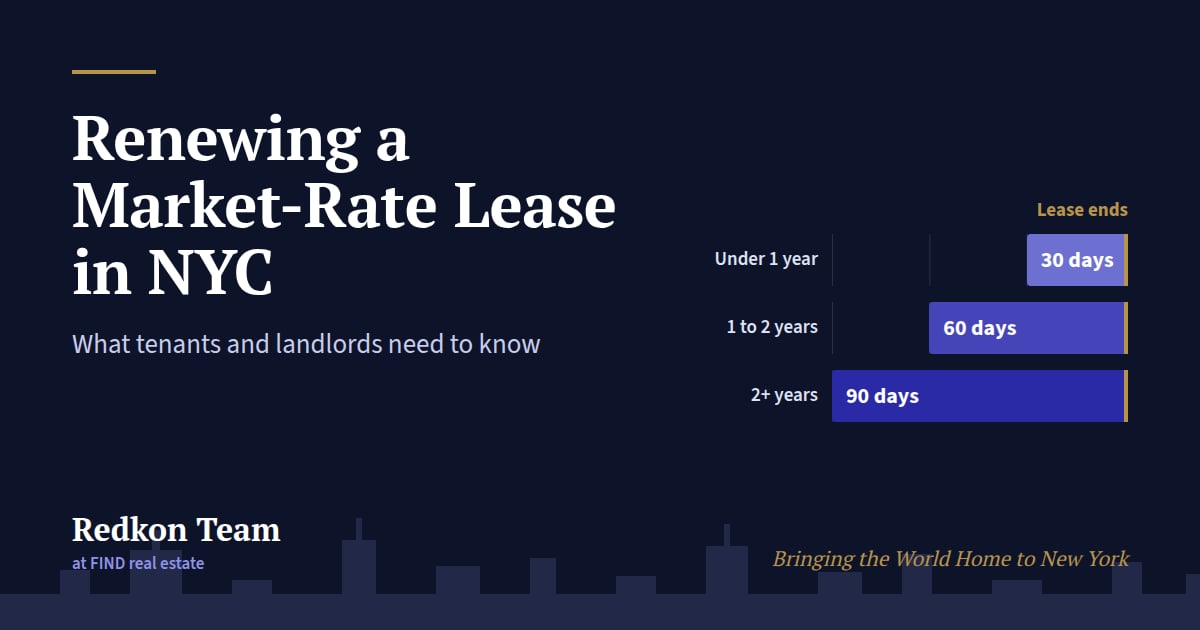
Renewal notices: the 30/60/90-day rule
If a landlord plans to raise the rent by 5% or more at renewal, or not to renew at all, written notice is required in advance. The length depends on how long the tenant has lived in the apartment or the length of the lease, whichever is longer (Real Property Law § 226-c).
What if notice comes late? The tenant may stay on the current rent and terms until the full notice period has passed, counted from the day proper written notice was actually given. The lease cannot override this.
Since 2024, the notice must also state whether the apartment is covered by New York's Good Cause Eviction law and, if exempt, why.
Deposits, application fees and late fees
The 2019 law set hard caps on what a landlord may collect, at move-in and during the lease (NY Attorney General summary).
If the landlord misses the 14-day deadline or skips the itemized list, they lose the right to keep any part of the deposit, even for real damage.
Breaking a lease, screening and late rent
The 2019 law also changed what happens when a tenant leaves early or falls behind (NY Attorney General summary).
- Duty to mitigate. If a tenant moves out before the lease ends, the landlord must make reasonable efforts to re-rent at fair market value. The tenant is generally responsible only until a new tenant takes over.
- No tenant blacklists. Landlords may not reject an applicant because of a past housing court case.
- Late rent notice. If rent is more than 5 days late, the landlord must send written notice of non-payment by certified mail.
- 14-day rent demand. Before starting a non-payment case, the landlord must give a 14-day written demand (it used to be 3 days).
- Hardship stays. A court may delay an eviction for up to one year if the tenant shows serious hardship.
What has changed since 2019
Two newer laws now sit on top of the 2019 rules for many market-rate apartments.
Good Cause Eviction (2024)
For covered apartments, a landlord needs a legal reason, such as unpaid rent or a lease violation, to refuse a renewal. A rent increase above the “local rent standard” (inflation plus 5%, capped at 10%) is presumed unreasonable and can be challenged. DHCR’s most recent annual notice puts the NYC standard at 8.38%. It is updated every year, so check the current figure before each renewal (NYC guidance).
Is your apartment covered?
Work through the common exemptions in order. A “yes” to any of them generally means the apartment is exempt (NAA summary).
- Does the owner have 10 or fewer units in New York State?Yes = exempt
- Is it an owner-occupied building with 10 or fewer units?Yes = exempt
- Was the certificate of occupancy issued in 2009 or later? (exempt for 30 years)Yes = exempt
- Is the rent above 245% of HUD fair market rent for the area?Yes = exempt
- Is the apartment already rent-regulated or government-subsidized?Yes = exempt
- No to all of the above: the apartment is likely covered by Good Cause.
Many individual condo owners who rent out one apartment fall under the small-landlord exemption.
FARE Act (2025)
Since June 11, 2025, a broker hired by the landlord, including any broker who lists the apartment with the landlord’s permission, cannot charge the tenant a fee. Landlords must also disclose all tenant-paid fees in listings and leases (NYC311, NYC DCWP FAQ). A tenant who hires their own broker still pays that broker. In July 2026, a federal appeals court upheld the law.
Renewal checklists
For tenants
- Note your move-in date and lease length; they set your 30, 60 or 90-day notice period.
- Check that a renewal offer of 5% or more arrived on time and in writing.
- Look for the Good Cause notice and see whether your apartment is covered or exempt.
- If covered, compare the increase to the current local rent standard.
- Confirm your deposit stays at or below one month’s rent.
- Compare the offer to similar apartments nearby before you negotiate.
For landlords
- Track every lease end date and send notices 100+ days ahead.
- Put any increase of 5% or more in writing, with the Good Cause notice attached.
- Confirm whether your unit is covered by Good Cause or exempt, and state the reason.
- Keep the deposit within one month of the new rent; return it within 14 days at move-out.
- Cap late fees at $50 or 5%, and only after 5 days.
- Disclose all tenant-paid fees in listings and leases under the FARE Act.
The bottom line
A market-rate lease in New York is not “no rules.” Since 2019, both sides have clear timelines and caps, and newer laws have added more. Knowing them early makes renewal season smoother for tenants and owners alike.
Whether you are renewing, leasing out an investment apartment, or deciding between renting and buying, Redkon Team is here to help you navigate the Manhattan market.
Bringing the World Home to New York
Konstantin Zaliznyak | Redkon Team | Licensed Associate Real Estate Broker
This article is for general information only and is not legal advice. Laws and annual figures change; consult a New York real estate attorney about your specific situation.